
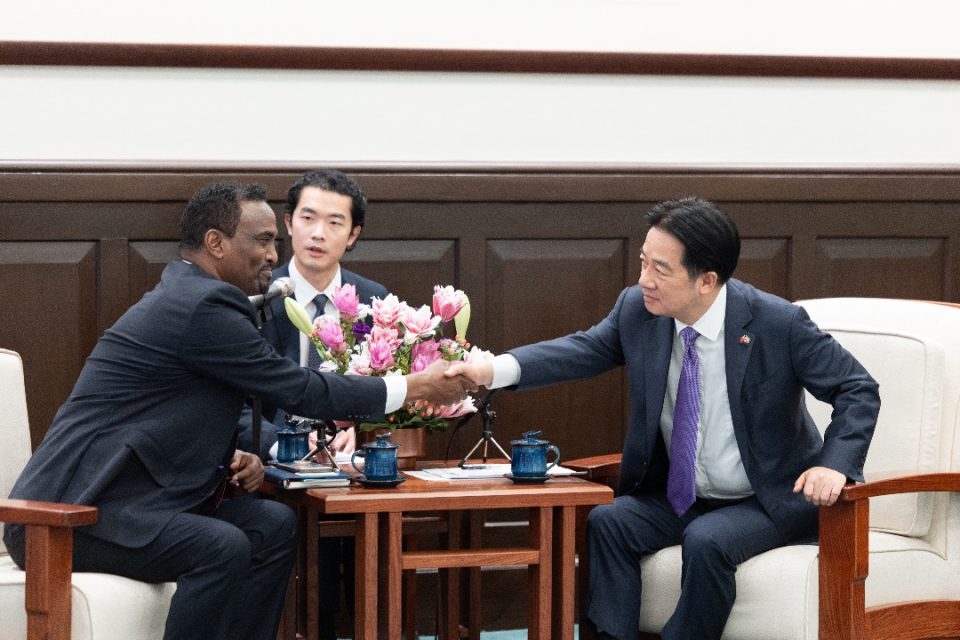

Since 2007, the Republic of China (Taiwan) and Somaliland have steadily deepened their bilateral relations, culminating in the signing of a Bilateral Protocol on February 26, 2020, in Taipei. This agreement established mutual representative offices, granting privileges equivalent to those accorded under the Vienna Convention on Diplomatic Relations.
After the protocol was signed, Essa Kayd Mohamoud, who was then Somaliland’s Minister of Foreign Affairs, met with Tsai Ing-wen, then President of Taiwan. On July 3, 2020, Luo Zhenhua became Taiwan’s first representative to Somaliland, while Mohamed Hagi became Somaliland’s inaugural representative to Taiwan. The Taiwan Representative Office in Hargeisa was officially inaugurated on August 17, 2020.
In July 2025, the two governments signed a landmark Coast Guard Cooperation Agreement in Taipei to enhance maritime security. The agreement provides for joint training, maritime rescue operations, and personnel exchanges to strengthen Somaliland’s coastal defense along the Gulf of Aden. Building upon the establishment of reciprocal representative offices in 2020, this initiative marks a shift from development-focused assistance toward strategic maritime and economic cooperation.
several U.S. Republican senators have characterized Somaliland as a strategic democratic partner capable of counterbalancing China’s expanding influence in Africa
The agreement holds considerable geopolitical significance, given the Gulf of Aden’s vital maritime routes and Somaliland’s extensive Exclusive Economic Zone (EEZ). It also comes amid heightened tensions with both China and Somalia, which continue to oppose the Taiwan–Somaliland partnership. Beijing has expressed strong disapproval, viewing the relationship as a direct challenge to its “One China” principle and a potential precedent for other regions seeking international recognition outside its influence.
China supports Somalia’s claim over Somaliland in exchange for Mogadishu’s adherence to the One China principle. Consequently, Beijing’s backing of Somalia and its condemnation of Taiwan– Somaliland’s growing ties have intensified geopolitical tensions in the Horn of Africa, where Taiwan’s engagement is viewed as challenging both Chinese and Somali sovereignty narratives. Conversely, several U.S. Republican senators have characterized Somaliland as a strategic democratic partner capable of counterbalancing China’s expanding influence in Africa. They have called for closer U.S.–Somaliland relations and even formal recognition, arguing that such support would reinforce democratic governance while serving as a geopolitical counterweight to Beijing.
What began as a modest diplomatic exchange has evolved into a multifaceted strategic partnership. Taiwan’s recent Joint funding of a new road connecting Egal International Airport to central Hargeisa stands as a tangible symbol of the deepening relationship between the two parties.
Somaliland, while lacking formal international recognition since its unilateral declaration of independence from Somalia in 1991, has developed a nascent democratic system and a level of political stability uncommon in the Horn of Africa
For Somaliland, partnership with Taiwan represents a pragmatic opportunity to attract foreign investment and diversify its economy. Taiwan’s own development trajectory—rooted in industrial innovation, export orientation, and resilience under diplomatic isolation—offers a model for Somaliland to emulate. Both Taiwan and Somaliland operate outside the world’s most formal international frameworks, yet each has transformed diplomatic marginalization into a form of strategic autonomy.
Excluded from the United Nations since 1971, Taiwan has nonetheless built a high-income, innovation-driven economy through trade and investment. Somaliland, while lacking formal international recognition since its unilateral declaration of independence from Somalia in 1991, has developed a nascent democratic system and a level of political stability uncommon in the Horn of Africa. Somaliland has a history of conducting competitive elections that have consistently resulted in the peaceful transition of political authority.
This shared experience of diplomatic exclusion has fostered a natural affinity between Taiwan and Somaliland. For Somaliland, Taiwan represents both a source of investment and an avenue for economic diversification beyond livestock exports and diaspora remittances. Livestock currently accounts for roughly 60% of Somaliland’s gross domestic product and around 85% of its export earnings, while remittances remain a vital economic lifeline, sustaining household incomes and domestic consumption.
For Taiwan, Somaliland presents a promising market and development partner. In 2023, Taiwan’s aquaculture sector alone generated NT$40.2 billion (US$1.3 billion), representing more than 40% of its total fisheries output.
Stretching over 850 kilometers along the Gulf of Aden, Somaliland’s coastline ranks among the richest yet least exploited in the Horn of Africa. Its waters host abundant stocks of tuna, mackerel, sardines, and lobsters, but the fisheries sector remains underdeveloped—limited by artisanal methods, weak infrastructure, and restricted access to regional and global markets. Persistent illegal, unreported, and unregulated (IUU) fishing by foreign vessels further depletes marine resources and erodes potential revenue. The absence of cold storage facilities, modern fishing vessels, and efficient logistics systems prevents much of Somaliland’s catch from reaching high-value export markets.
Somaliland’s coastal hubs—Berbera, Maydh, and Saylac—offer particularly promising opportunities for joint investment. For Taiwan, these ports could serve as strategic gateways for trade and investment into the Red Sea and East African markets. For Somaliland, collaboration with Taiwan could unlock the capital and technology needed to harness its untapped marine resources and modernize its fisheries sector.
Through such cooperation, Taiwan and Somaliland can transform shared isolation into mutual advantage, laying the foundation for a partnership grounded in democratic values and pragmatic development.
To realize this vision of shared prosperity, Somaliland must address the structural barriers that continue to deter investment—namely, inadequate infrastructure, institutional constraints, and limited technical capacity. Ports, transport networks, and cold-chain systems require modernization to meet international standards. Simultaneously, regulatory frameworks must be strengthened and investment incentives clarified to create a transparent, predictable business environment conducive to private-sector participation.
If pursued strategically, Somaliland could leverage access to Taiwan’s dynamic free market to develop new outlets for its underutilized marine and fisheries resources. Such engagement would help Somaliland diversify its economy—long reliant on livestock, remittances, and an informal private sector—while promoting export-led growth through targeted investments and joint ventures. Collaboration in fisheries and aquaculture could generate substantial employment, strengthen value chains, and reduce Somaliland’s heavy dependence on imports.
